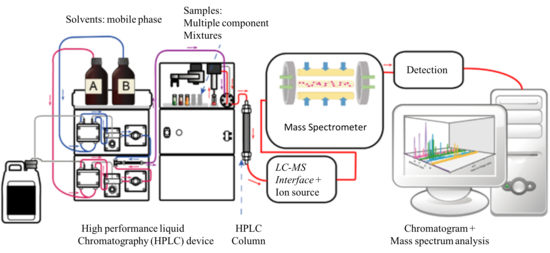
LC-MS (or HPLC-MS, Liquid Chromatography – Mass Spectrometry) is the combination of the physico-chemical separation capabilities of liquid chromatography with the mass analysis capabilities of mass spectrometry. Generally it is used for the detection and identification of chemicals in the presence of other chemicals (in a complex mixture or matrix).
The principle of LC-MS/MS is based on the fragmentation of charged ions and the detection of the resulting fragments. The interface is a particle beam type, which separates the sample from the solvent, and allows the introduction of the sample in the form of dry particles into the high vacuum region. Electron impact is of interest for molecules which do not ionize with API technique, or when an electron impact spectrum is necessary, since it provides spectral information independent of the sample introduction technique (GC or LC, or direct introduction) and instrument supplier. Thus, it has a much higher selectivity and sensitivity than the traditional GC or GC-MS techniques and even makes it possible to elucidate metabolite structures.