Pulmonary function tests (PFTs) are noninvasive tests that show how well the lungs are working. The tests measure lung volume, capacity, rates of flow, and gas exchange. This information can help your healthcare provider diagnose and decide the treatment of certain lung disorders.
There are 2 types of disorders that cause problems with air moving in and out of the lungs:
- Obstructive. This is when air has trouble flowing out of the lungs due to airway resistance. This causes a decreased flow of air.
- Restrictive. This is when the lung tissue and/or chest muscles can’t expand enough. This creates problems with air flow, mostly due to lower lung volumes.
PFT can be done with 2 methods. These 2 methods may be used together and perform different tests, depending on the information that your healthcare provider is looking for:
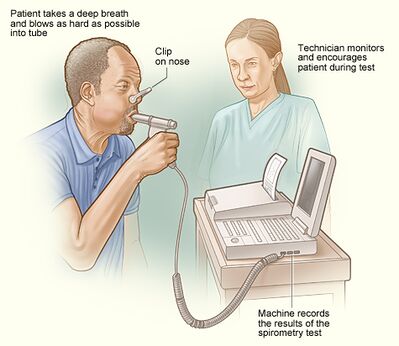
- Spirometry. A spirometer is a device with a mouthpiece hooked up to a small electronic machine.
- Plethysmography. You sit or stand inside an air-tight box that looks like a short, square telephone booth to do the tests.
PFT measures:
- Tidal volume (VT). This is the amount of air inhaled or exhaled during normal breathing.
- Minute volume (MV). This is the total amount of air exhaled per minute.
- Vital capacity (VC). This is the total volume of air that can be exhaled after inhaling as much as you can.
- Functional residual capacity (FRC). This is the amount of air left in lungs after exhaling normally.
- Residual volume. This is the amount of air left in the lungs after exhaling as much as you can.
- Total lung capacity. This is the total volume of the lungs when filled with as much air as possible.
- Forced vital capacity (FVC). This is the amount of air exhaled forcefully and quickly after inhaling as much as you can.
- Forced expiratory volume (FEV). This is the amount of air expired during the first, second, and third seconds of the FVC test.
- Forced expiratory flow (FEF). This is the average rate of flow during the middle half of the FVC test.
- Peak expiratory flow rate (PEFR). This is the fastest rate that you can force air out of your lungs.
Normal values for PFTs vary from person to person. The amount of air inhaled and exhaled in your test results are compared to the average for someone of the same age, height, sex, and race. Results are also compared to any of your previous test results. If you have abnormal PFT measurements or if your results have changed, you may need other tests.