
HIGH PERFORMANCE LIQUID CHROMATOGRAPHY (HPLC)
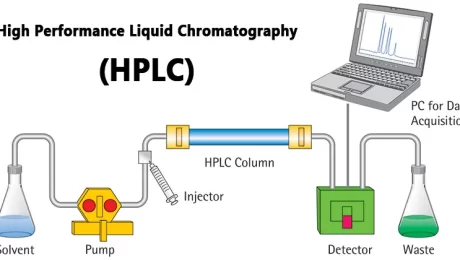
When molecules in the mixture are very similar, direct quantification becomes difficult. HPLC is a form of column chromatography used frequently to separate, identify and quantify compounds. It consists of a stationary phase that absorbs the analytes and holds them for a particular time. All the molecules in the mixture will spend different time with different stationary phase and then come out at the end. The time that a molecule takes to travel from one end to the other end of stationary phase is known as Retention time. Hence, all the molecules display their own unique retention time for particular stationary-mobile phase combination. Silicagel is most frequently used as the adsorbent which is packed in a column. HPLC columns are densely packed as packing directly affects the resolution. A detector is kept at the end of the column. As the molecules come out from the end, the detector detects and gives a peak on chromatogram. The peak area calculation quantifies the molecule of interest on the basis of standard values.
- Published in Technology
ENZYME LINKED IMMUNOSORBENT ASSAY (ELISA)
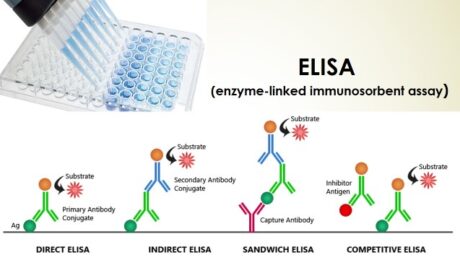
ELISA is an immunological technique which is used to detect the presence of an antibody or an antigen in a sample. A known amount of antigen is coated on a solid phase like that in the well of a polystyrene microtitre plate and sample containing specific antibodies is added in the wells to allow antigen-antibody binding. The immune complex thus formed is linked to an enzyme, which acts on a substrate to give a coloured reaction which is detected using ultramodern ELISA plate readers. Since ELISA technique utilizes enzyme labels to produce detectable signals, it is given the name Enzyme-Linked Immunosorbent Assay.
- Published in Technology
CHEMILUMINESCENCE IMMUNOASSAY (CLIA)
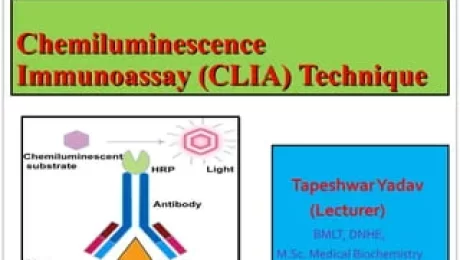
Chemiluminescence Immunoassay (CLIA) provides a sensitive, high throughput, fully automated immunological technique, which has revolutionized Immunodiagnostics. It measures the intensity of light emitted when the complex of antigen in the patient’s sample and the enzyme linked antibody react with chemiluminescent molecule (such as luminol) producing a weak signal. The enzyme component then provides signal amplification.
- Published in Technology